
Here's what actually matters when purchasing a pop up trade show display.
I have watched exhibitors spend $300 on a pop up display that falls apart after two shows and $1,500 on one that lasts seven years. From the outside, they look similar. Same general shape, same basic pitch, same promise of "easy setup." But the differences show up fast: the frame wobbles, the graphic wrinkles, the velcro stops holding, the case cracks. By the third show, you are shopping again.
The graphic attachment method is the single biggest differentiator
Most buyers overlook this completely. How the graphic attaches to the frame determines how your display looks, how long the graphic lasts, and how easy it is to swap.
Velcro Attachment (Older Method)
- Graphic sticks to velcro strips on the frame
- Edges curl and peel after repeated use
- Visible seams where velcro strips meet
- Graphic shifts out of alignment during transport
- Replacement graphics must match exact velcro placement
SEG / Silicone Edge Graphics (Current Standard)
- Silicone strip sewn into graphic edge presses into frame channel
- Seamless, frameless finish with no visible edges
- Graphic stays taut and aligned permanently
- Swap takes under 5 minutes with no tools
- Any replacement graphic fits the same channel

Every Displayit pop up display uses SEG attachment. A velcro pop up looks acceptable on day one. By show three, the edges are lifting and the graphic is misaligned. A SEG pop up looks the same on show twenty as it did on show one. If you are comparing pop up displays and the seller does not specify SEG graphics, assume it is velcro.
Why this matters for your budget: A pop up with SEG graphics costs more upfront but saves money over time because replacement graphics are simpler, cheaper, and universally compatible with the frame channel. A velcro pop up locks you into the exact velcro configuration of that specific frame.
Frame construction determines whether your display lasts 2 years or 10
Pop up frames are either collapsible accordion-style (fold flat) or push-fit modular (assemble from tubes). Both work. The difference is aluminum quality, joint engineering, and how much abuse the frame handles over years of use.
| What to Check | Low-Quality Pop Up | Quality Pop Up |
|---|---|---|
| Frame Material | Thin-wall aluminum or steel, flexes under tension | Thick-wall aluminum extrusion, rigid under tension |
| Joint Quality | Plastic connectors that crack with repeated use | Machined metal connectors with positive-lock mechanisms |
| Stability | Wobbles when touched, leans over time | Stands rigid without wall support or counterweights |
| Expected Lifespan | 1-3 years / 5-15 uses | 5-10 years / 30+ uses |
| Price Range (10ft) | $300 - $600 | $1,000 - $1,600 |

A $400 pop up that lasts 2 years costs $200 per year. A $1,200 pop up that lasts 7+ years costs $171 per year and looks better the entire time. Most first-time buyers miss this math.
Flat vs. curved changes how your booth feels
Pop up displays come in flat and curved configurations. This is not just a cosmetic preference. It affects how the display fits in your booth space and how attendees perceive your presence.
Flat: Sits flush against the booth wall. Maximizes floor space. Best for inline booths.
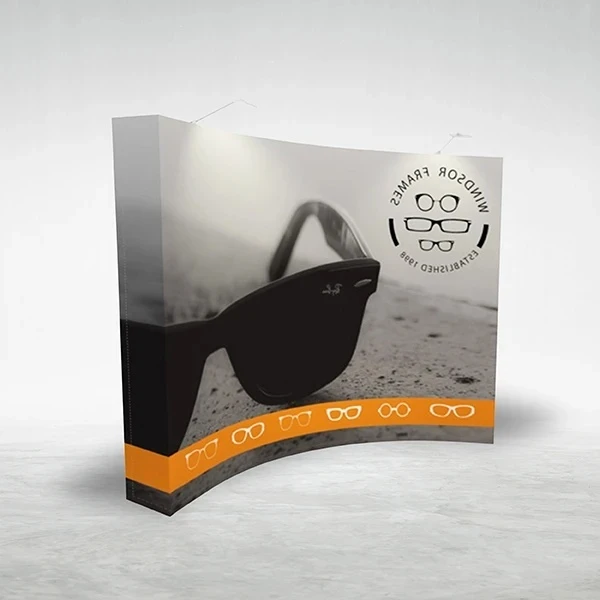
Curved: Creates a wraparound effect that draws the eye inward. Best for corner booths.
We sell both, and we do not push one over the other because the right choice depends on your booth layout. If you are in a standard 10x10 inline booth, a flat pop up is usually the better fit because it maximizes your usable floor space. If you have a corner or peninsula booth with open sides, a curved pop up wraps around to create more visual presence. For detailed layout options, see: 10x10 Trade Show Booth Ideas by Budget.
Size options and which one fits your booth
Pop up displays are available in 8-foot, 10-foot, and 20-foot widths. The right size depends on your booth dimensions and how much of the back wall you want covered.
| Pop Up Size | Best Booth Size | Coverage | Price Range |
|---|---|---|---|
| 8ft Pop Up | 10x10 | Covers 80% of back wall, leaves room for side displays | $900 - $1,200 |
| 10ft Pop Up | 10x10 | Full back wall coverage, strongest visual impact | $1,050 - $1,550 |
| 20ft Pop Up | 10x20 | Full 20-foot back wall, creates dominant booth presence | $1,495 - $2,200 |
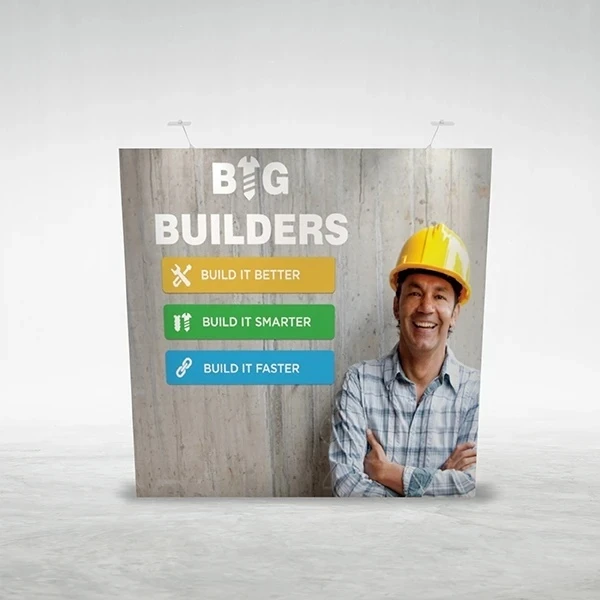
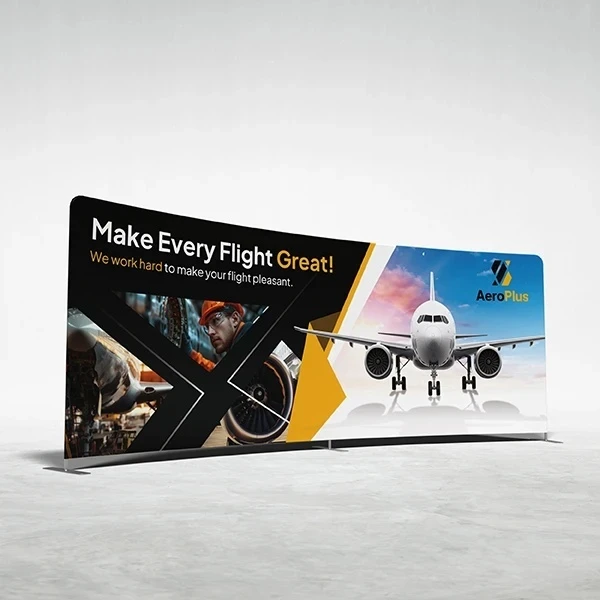
The 10-foot pop up is our highest-volume seller for 10x10 booths. It covers the full back wall and creates the strongest single-surface visual impact. The 8-foot is the right choice when you want to leave room for a banner stand or side panel on one end. The 20-foot is for exhibitors stepping up to a 10x20 booth who want a seamless backwall without assembling a multi-frame kit. For more on upgrading to a 10x20, see: 10x20 Trade Show Booth Ideas and Upgrade Guide.
When a pop up display is the right choice (and when it is not)
Pop up displays are the right choice for most exhibitors. But not every situation.
A pop up display is the right call when:
- You need a clean, professional backwall for a 10x10 or 10x20 booth
- One person is setting up the booth without hired labor
- You attend 2 or more shows per year and need durability
- You want a seamless, frameless look with SEG graphics
- You plan to refresh graphics every 1-2 years without replacing hardware
Consider something else when:
- You need multiple branded surfaces at different angles (a multi-frame kit is better)
- You want LED-illuminated graphics as the primary visual (backlit displays are purpose-built for this)
- You only attend one event per year and want the absolute lowest cost (a retractable banner stand paired with a table cover is more cost-effective)
- Your booth is larger than 10x20 and requires custom configurations
Why I share this openly: An exhibitor who buys the wrong display type and has a bad experience at their first show may never exhibit again. An exhibitor who buys the right display, even if it is a simpler and less expensive one, comes back. Our repeat customers are the core of our business. Getting the first purchase right matters more than getting the biggest first purchase.
What a complete pop up display setup should include
A pop up display is a backwall. A complete booth pairs it with accessories:
| Setup Level | What's Included | Total Price |
|---|---|---|
| Essential | 10ft pop up display + branded table cover | $1,285 - $1,910 |
| Complete | 10ft pop up display + branded table cover + banner stand + counter | $1,885 - $2,870 |
The essential setup covers 80% of the visual impression. The table cover handles the bottom half, the pop up handles the top. Adding a banner stand and counter fills the space without cluttering it. For more on building a display system over time, see: How a Banner Stand Can Grow Your Business.
How to evaluate any pop up display before you buy
Whether you buy from Displayit or anyone else, ask these five questions before ordering:
The bottom line: A pop up trade show display is one of the best investments an exhibitor can make. But only if the frame is built to last, the graphic attachment is SEG, and the company behind it can support you with replacements, design help, and fast production when your next show is two weeks away.
Browse the full trade show display collection to compare pop ups against every other display type, or try our interactive Trade Show Display Buying Guide for a personalized recommendation. For questions about which pop up fits your booth, talk to our team.

About the Author
Adam Chait is the CEO of Displayit, a U.S. based trade show display manufacturer that has been helping companies exhibit with confidence since 1996. Displayit designs, prints, and ships custom trade show displays from its facility in Buford, GA, serving thousands of exhibitors across every major industry. Adam leads a team of display specialists who work directly with exhibitors to match the right booth solution to their space, timeline, and budget. For personalized guidance, schedule a free consultation with the Displayit team.